About Business Model Canvas
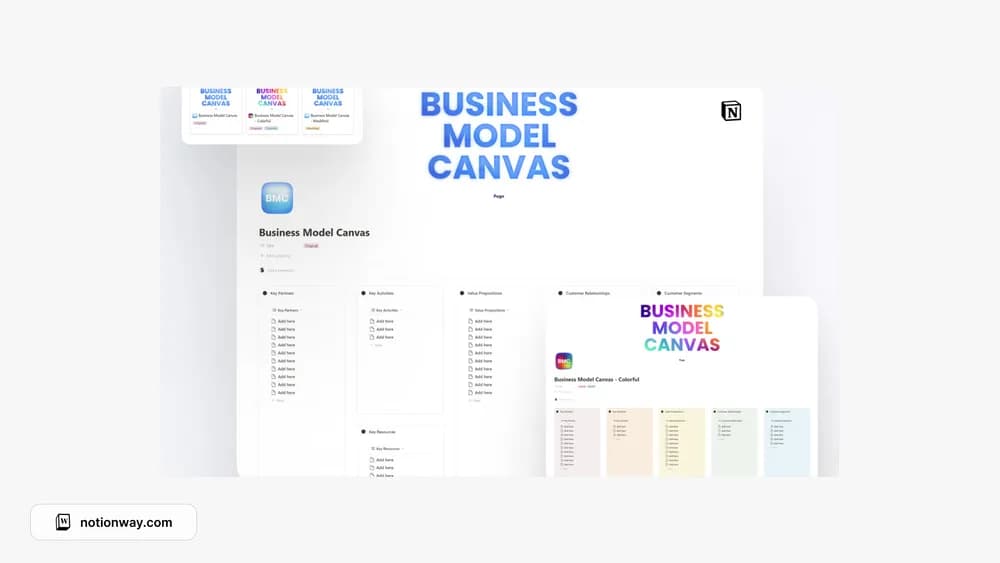
A business model canvas gives you a compact way to examine how the pieces of a business fit together. Use the template to make assumptions visible, especially around customers, value, costs, and revenue. The canvas becomes more useful as you replace guesses with evidence.
What’s included
- A nine-part Business Model Canvas
- Prompts for customers, value, channels, relationships, activities, resources, and partners
- Sections for cost structure and revenue streams, with Notion and Figma formats described
How to use it in practice
Complete the canvas for one offer and one customer group. Mark assumptions that still need evidence, then choose a low-cost test for the most important one. As you learn, update the affected sections together: a new delivery channel may change both the cost structure and the customer relationship. Keep earlier versions if you want a record of how the model changed.
Set it up in your workspace
- Follow the original creator’s checkout or access instructions to obtain the Notion page. Open that page while signed in, then duplicate it into the workspace you want to use.
- Complete a first pass in plain language. Mark the two assumptions that most need a real-world test.
- Try one complete example before adding a large backlog. Check that its views and any calculations show what you expect, then replace the sample content with your own.
Who it suits and what to consider
Founders and small-business owners shaping an offer. Suited to early thinking and team discussion. It provides a compact model of a business; financial forecasts and detailed delivery plans may need their own supporting documents.