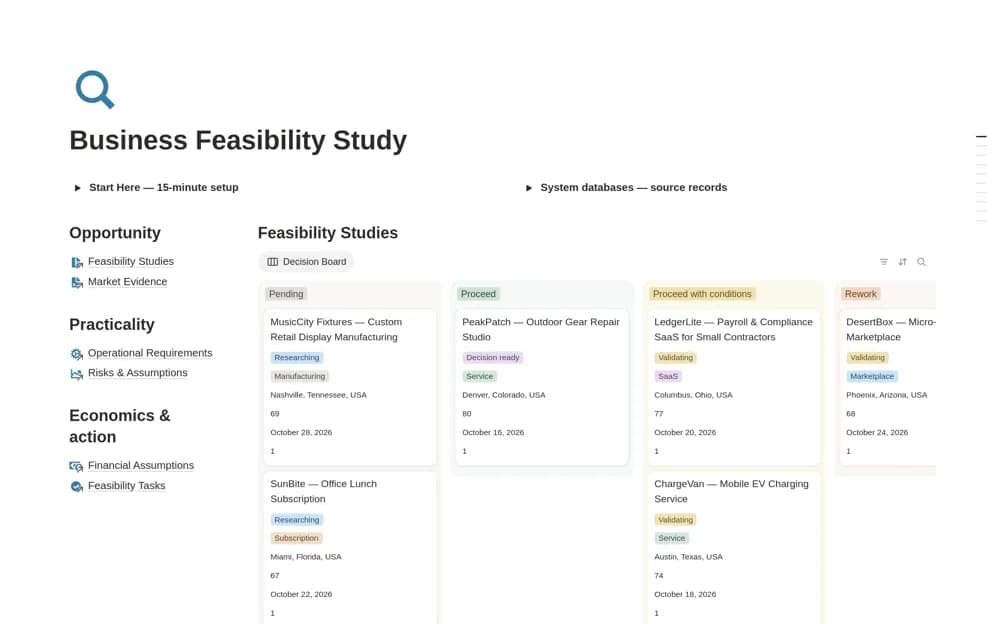
 Free
Business Feasibility Study
A feasibility workspace connecting market evidence, financial assumptions, operations, risks, and decisions.
Compare alternatives with evidence you can revisit. Explore Notion competitive analysis templates for products, positioning, pricing observations, strengths, gaps, and the implications for your own work.
Showing 1–3 of 3 templates
FreeA feasibility workspace connecting market evidence, financial assumptions, operations, risks, and decisions.
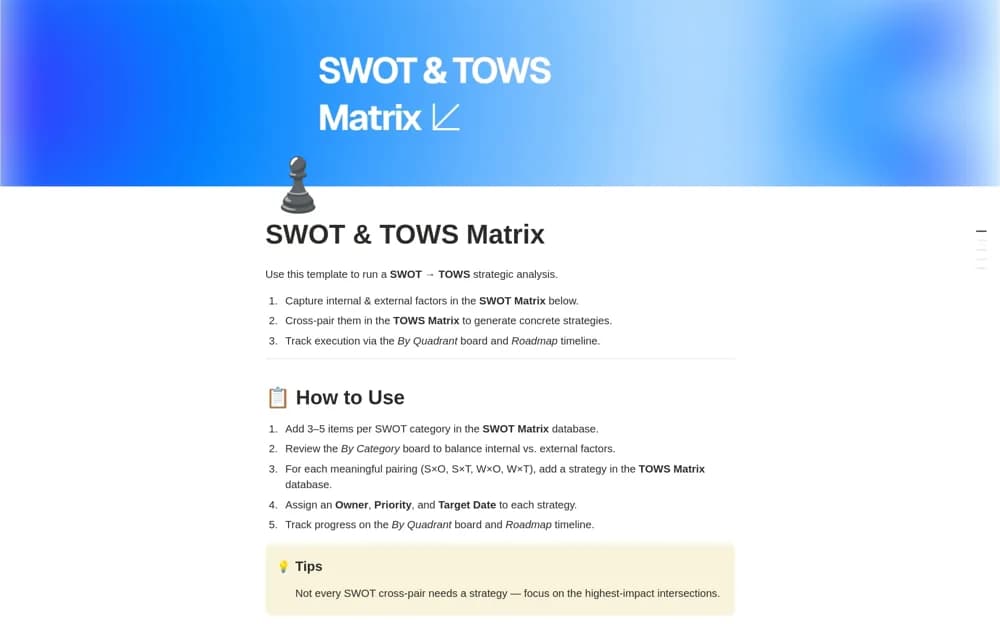 Paid
A strategy workspace connecting SWOT observations to TOWS options, owned actions, priorities, and a roadmap.
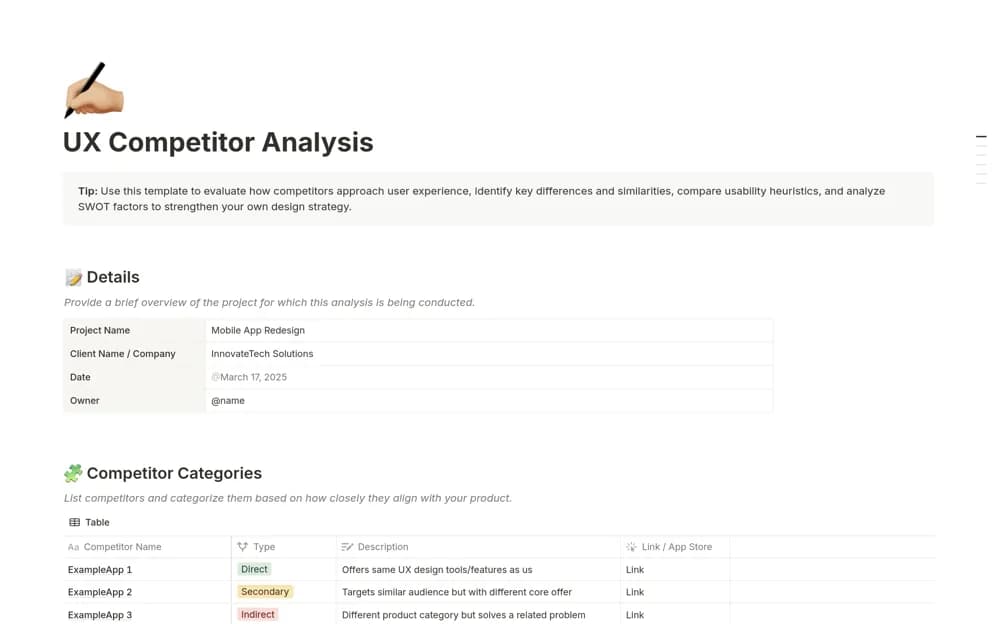 Free
A UX comparison framework for competitor types, similarities, differences, heuristic observations, and SWOT analysis.
Compare the purpose and included features before choosing a workspace.
Founders and consultants comparing a business idea or expansion opportunity.
Designers and researchers structuring a comparative product review.
Teams moving from a strategic discussion to a documented set of choices.
3 working templates from 3 creators: 2 free and 1 paid, with paid options from $2.49. Links last checked October 11, 2026.
| Template | Best for | Price | Creator |
|---|---|---|---|
| Business Feasibility Study | Founders and consultants comparing a business idea or expansion opportunity. | Free | heyismail |
| UX Competitor Analysis | Designers and researchers structuring a comparative product review. | Free | Anastasiia Firsova |
| SWOT & TOWS Matrix | Teams moving from a strategic discussion to a documented set of choices. | $2.49 | Hafidz Noor Fauzi |
Choose competitors or alternatives relevant to a specific decision. Use consistent criteria and save the source and date of each observation. Distinguish a publicly stated claim from something you have tested. Summarize what the comparison changes about your next action, rather than collecting every feature. Recheck important facts before presenting an older analysis as current.
Consistent comparison criteria
Dated source evidence
Practical implications
About the directoryDefine the customer problem and market segment before collecting competitors. Record the source and date for pricing, positioning, and product claims. Separate observed facts from your interpretation and flag gaps instead of filling them with guesses. Use the comparison to identify a research or positioning question worth acting on.
Jump straight to any listing in the collection.
Review it when a material claim affects a real decision, such as pricing or positioning. Volatile information needs a dated source and more frequent checking than background context. A scheduled reminder helps only if someone owns the actual review.
It depends on the job you need it to do. Good starting points in this collection include Business Feasibility Study (founders and consultants comparing a business idea or expansion opportunity), UX Competitor Analysis (designers and researchers structuring a comparative product review) and SWOT & TOWS Matrix (teams moving from a strategic discussion to a documented set of choices). Compare the included features below, then try your first choice with a week of real information before moving everything across.
Yes. This collection currently includes 2 listings with a confirmed free creator offer, alongside 1 paid or freemium option. Use the Free filter to compare them. A free version can have different features from a creator’s paid upgrade, so check the original listing and current access terms before adding it to your workspace.