About Incident Management
An incident record should make the sequence of events and the remaining work understandable. This template is a starting structure for that documentation. Keep the factual timeline separate from later interpretation, and make agreed follow-ups visible after the immediate problem has passed.
What’s included
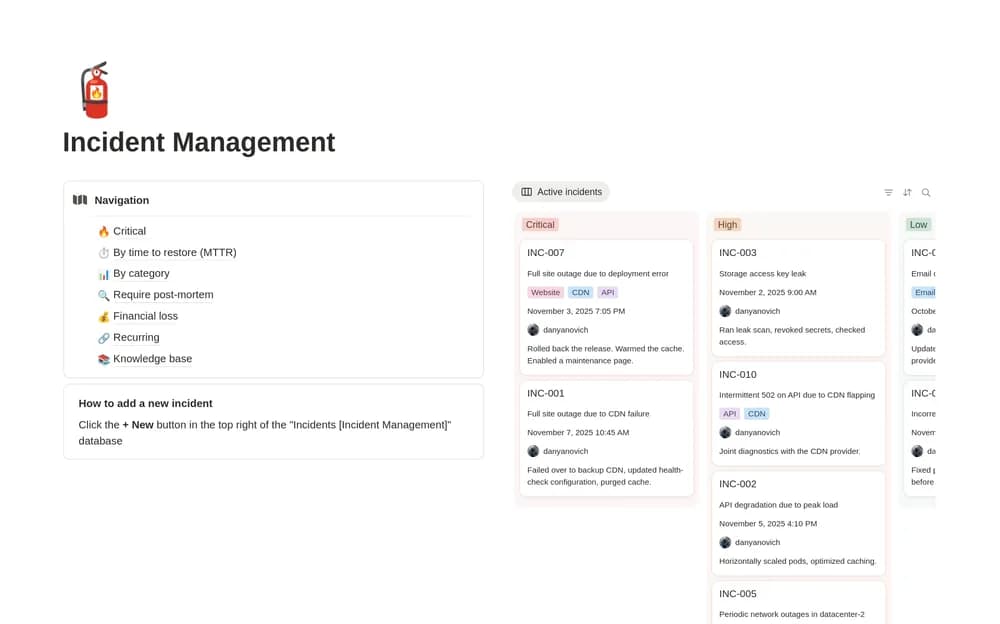
- Incident priority, ownership, detection, and recovery records
- Response and recovery context including RTO or RPO fields
- Root-cause and recovery-step documentation with several review views
How to use it in practice
Document a past incident first to test the structure. Record the factual sequence and actual times before adding interpretation. Keep response decisions and recovery evidence close to the timeline, then assign follow-up actions after the service is restored. Review whether someone outside the response can understand what happened.
Set it up in your workspace
- Open the original Notion Marketplace listing and add the template to your chosen workspace while signed in. Keep its example records until you understand how the pages connect.
- Document a past non-sensitive incident. Check whether another person can understand the timeline and outstanding actions.
- Try one complete example before adding a large backlog. Check that its views and any calculations show what you expect, then replace the sample content with your own.
Who it suits and what to consider
Teams documenting operational incidents. Useful for preserving operational context and follow-up. Enter recovery targets and actual outcomes separately so a target is not mistaken for observed performance.