 Free
Agile retrospective
Run an Agile retrospective in Notion with cards for feedback, learning, actions, voting, and recognition for teammates’ contributions.
Turn a team review into useful changes. Explore Notion retrospective templates for observations, discussion themes, agreed experiments, and following through after the meeting.
Showing 1–3 of 3 templates
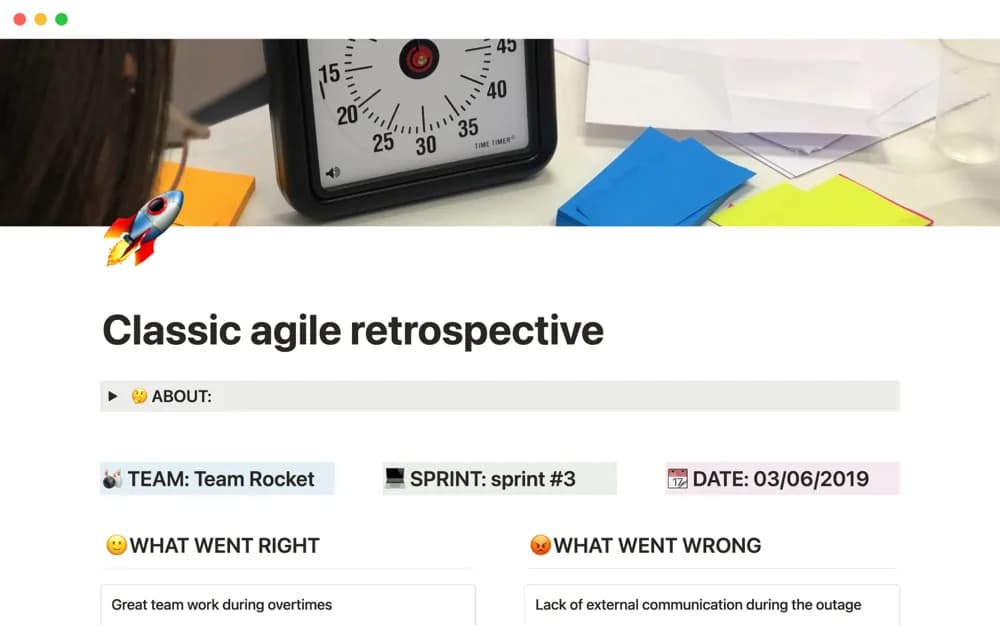
FreeRun an Agile retrospective in Notion with cards for feedback, learning, actions, voting, and recognition for teammates’ contributions.
 Free
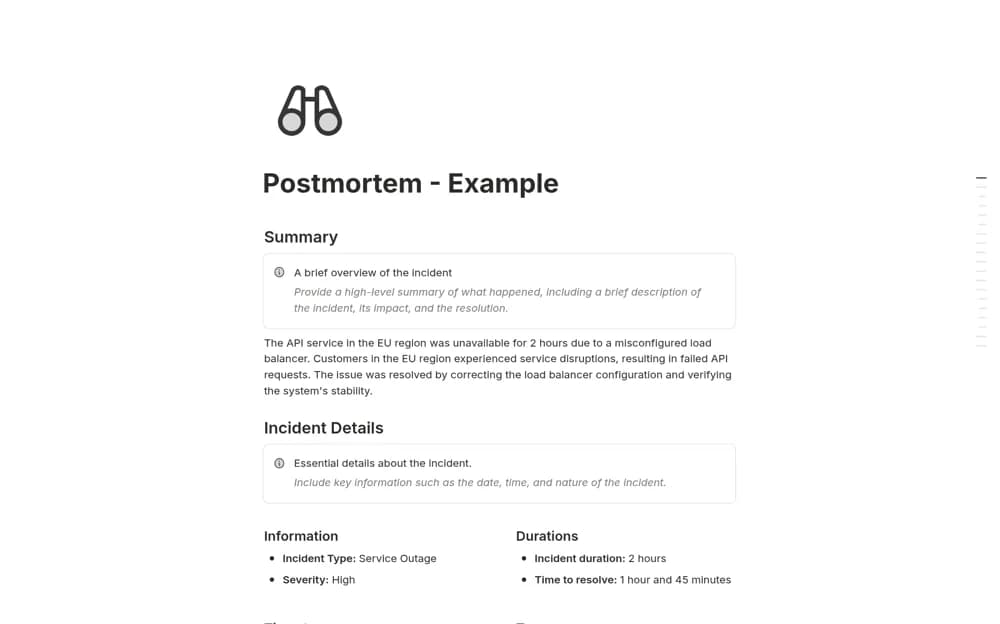
An incident review framework for timelines, impact, contributing factors, resolution, and owned prevention work.
 Free
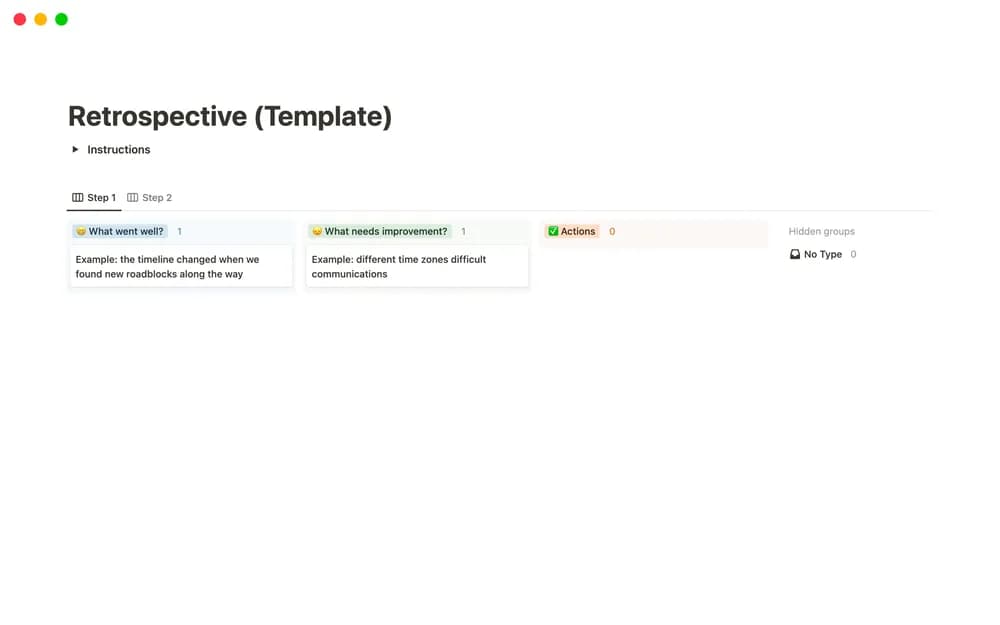
Give a development retrospective a clear place for observations and actions.
Compare the purpose and included features before choosing a workspace.
Teams reviewing a completed sprint or working period and choosing a small set of improvements.
Teams documenting what happened after a service incident or failure.
Software teams reviewing a recent delivery cycle.
3 working templates from 3 creators: 3 free. Links last checked October 12, 2026.
| Template | Best for | Price | Creator |
|---|---|---|---|
| Agile retrospective | Teams reviewing a completed sprint or working period and choosing a small set of improvements. | Free | Fred de Villamil |
| Postmortem Starter | Teams documenting what happened after a service incident or failure. | Free | Marco Elizalde |
| Software Development Retrospective | Software teams reviewing a recent delivery cycle. | Free | Gabriel Poça |
Collect examples of what happened rather than broad judgments about people. Give the team a way to contribute before the conversation, then choose a small number of changes it can test. Assign an owner and review date to each experiment. Open the next retrospective by checking those actions so the process does not become a repeated list of unresolved frustrations.
Specific observations
A few agreed experiments
Owners and review dates
About the directoryCollect observations from the period and examine a small number of recurring or consequential issues. Separate what happened from assumptions about its cause. Agree a practical change, an owner, and when to review it. At the next retrospective, check the result of the previous action before opening another long list of improvements.
Jump straight to any listing in the collection.
A status meeting coordinates current work. A retrospective examines how the team worked and what to improve. It should lead to a considered experiment or action, rather than repeating progress reports or collecting complaints without follow-through.
It depends on the job you need it to do. Good starting points in this collection include Agile retrospective (teams reviewing a completed sprint or working period and choosing a small set of improvements), Postmortem Starter (teams documenting what happened after a service incident or failure) and Software Development Retrospective (software teams reviewing a recent delivery cycle). Compare the included features below, then try your first choice with a week of real information before moving everything across.
Yes. This collection currently includes 3 listings with a confirmed free creator offer. Use the Free filter to compare them. A free version can have different features from a creator’s paid upgrade, so check the original listing and current access terms before adding it to your workspace.